What Happened and Why It Matters
A Ukrainian company has received a conformity certificate for the lightweight remote-controlled demining machine UDM VORMELA. The announcement was made by the Ministry of Economy, Environment and Agriculture. While the news may seem purely technical, it is actually about the speed of the country's recovery and the safety of people on land where explosive ordnance still remains.
Demining is not just about military security. It is about being able to return fields to cultivation, restore access to roads, rebuild infrastructure, launch businesses, and bring people back to their communities. When certified Ukrainian-made equipment appears, it means the country is building a sustainable ecosystem — from engineering innovation and manufacturing to the official recognition of quality and safety.
A conformity certificate is not just a "rubber stamp." It is proof that the machine meets requirements and can operate in real-world conditions. For the market, it is a signal of trust; for the government — confirmation that solutions can be scaled; and for investors and donors — a clear framework of accountability.
There is also a human dimension. Certification gives confidence to those who will operate the equipment on the ground. For demining specialists, it means predictable machine behavior; for communities — the assurance that the government and businesses are taking responsibility for quality. And even for those who simply want to safely return to their land, it is a sign: the recovery process follows clear rules, not a "whatever works" approach.
UDM VORMELA Capabilities in Plain Terms
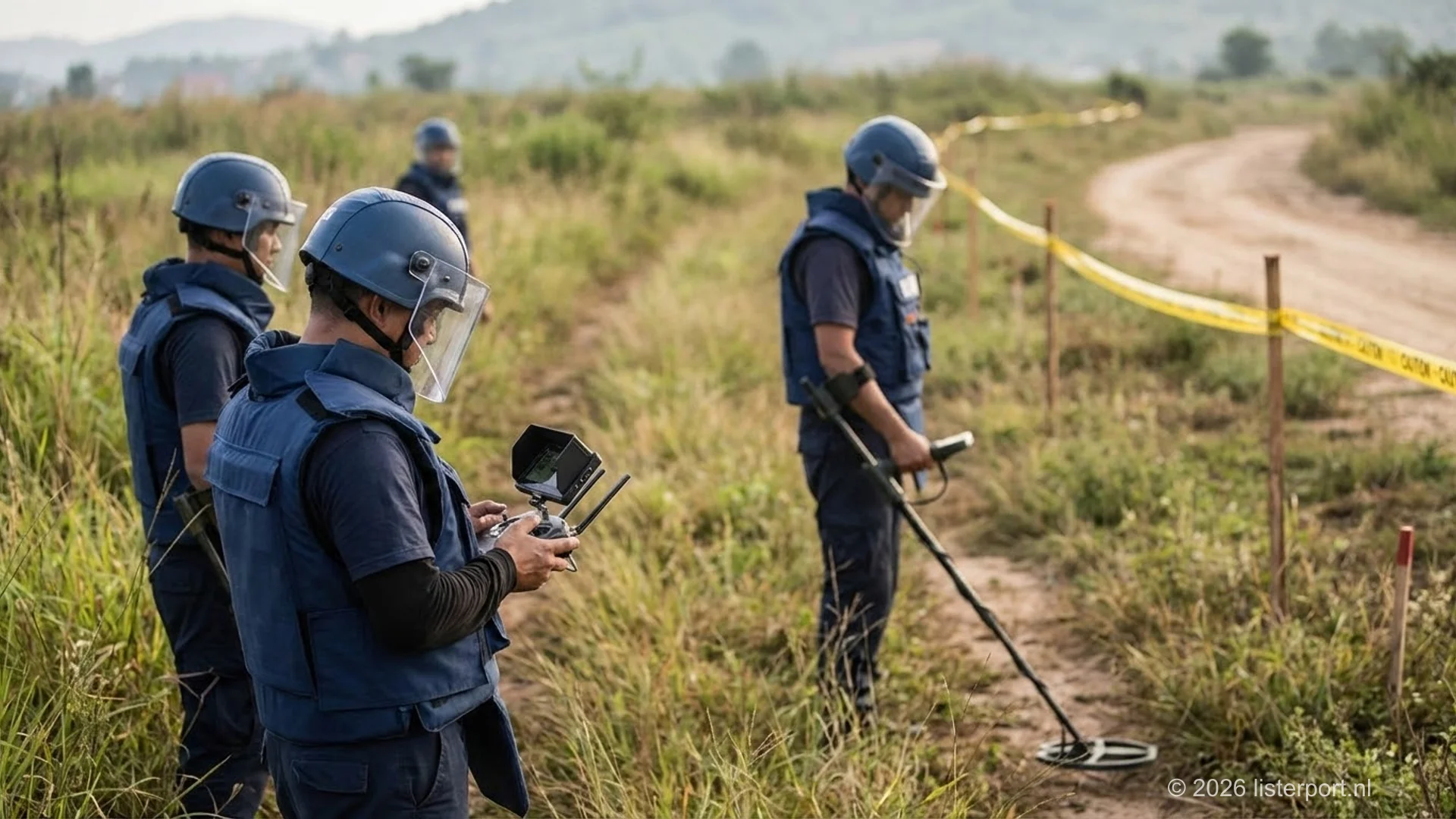
UDM VORMELA is a lightweight demining machine operated remotely. The core idea is simple: the operator works at a distance while the machine performs the dangerous work. This approach reduces risk to people and allows for faster action in areas where danger is particularly high.
According to its specifications, the machine clears 1,500–2,500 m² per hour — depending on the soil type and vegetation density. To put this in perspective: under good conditions, that is several football fields per work shift. The processing depth is up to 25 cm, which is important because many explosive items can be partially buried.
These figures are not just statistics. For a community, it means less time waiting for a field or plot to become safe. For farmers — the ability to get back to work sooner. And for the government — more efficient use of resources, since a single certified machine can replace several slower solutions.
It is important to understand that productivity depends not only on the equipment but also on how operations are organized. The quality of preliminary surveys, team training, and regular maintenance all affect speed and outcomes. That is precisely why the conformity certificate matters: it sets a baseline from which realistic project timelines and budgets can be planned.
Protection and Safety: What Makes the Machine Reliable
A key component of UDM VORMELA is the hammer mulcher, which protects the main platform from detonations of hand grenades, unexploded cluster submunitions, anti-personnel mines, and other small explosive ordnance. This is a practical engineering solution: the machine operates on the front line, while its most vulnerable elements are shielded by a protective module.
The machine's body is made of Mars 500 armored steel, providing a critical level of protection against fragments and blast waves. In simple terms, this means the machine is designed to work in extremely high-risk areas and is built to "take the hit" instead of a person.
Safety in demining is always a system. Certification confirms that this system has been thought through — from design and materials to application methods. This is essential for government contracts, international support programs, and the domestic market, where every solution is tested in practice.
In demining, any solution that reduces risk to people is valued. Remote control adds another layer of safety: the operator is not near the potential threat. And the armored body and protective modules provide a chance to preserve the equipment and continue operations even after incidents — which is critical in field conditions.
Modularity and On-Site Operations: More Than Just Demining
UDM VORMELA is not a "one-function-only" machine. It features various types of attachments: a skeleton and standard bucket, a pallet loader, and a swivel blade. In practice, this means more types of work can be performed on a single site without bringing in additional equipment.
For communities, this is critical. Often after demining, it is necessary to quickly prepare the area for further work: level the ground, clear remaining vegetation, and organize logistics. When a single platform covers more tasks, it saves time and budget while speeding up operations.
The modular approach also increases flexibility for contractors. They can adapt the equipment to a specific project — aggressive clearing in one place, delicate work on infrastructure objects in another. For the professional market, this is an important factor in the decision-making process.
In practice, this helps build a comprehensive process: first demining, then initial site clearing, followed by preparation for construction or agricultural use. When all of this can be done on a single platform, the number of contractors and logistical arrangements is reduced. This means less time between "demined" and "ready to work."
Mobility and Logistics: Why 6 Tonnes Is an Advantage
The machine offers two chassis configurations: solid rubber wheels or bolt-on tracks. This allows it to adapt to various terrain types — from hard roads to heavy, wet, or uneven surfaces. In practice, this means fewer downtimes and better maneuverability in field conditions.
UDM VORMELA weighs six tonnes, and no specialized transport is required to move it. This is an important detail that is often underestimated. Logistics means money and time. If equipment can be quickly transported by standard means, it is easier to rapidly redeploy between sites.
For Ukraine, where the scale of work is vast and resources are limited, this kind of mobility can become a competitive advantage. It lowers the entry barrier for using the equipment in regions and makes it more accessible not only to large companies but also to mid-sized contractors.
Another advantage is response speed. When work in one region is completed, the equipment can be moved to another community without complex transportation arrangements. This is especially important for rural areas where access to heavy logistics is limited, yet the need for demining can be critical.
Localization and Economics: What 'Made in Ukraine' Really Means
The manufacturer notes that the machine uses foreign components — including a JOHN DEERE engine and PROCLAIN hydraulics. This is standard practice for modern equipment: global components often offer the best performance and service support. At the same time, the company emphasizes a high level of localization.
Why does this matter? Because localization means jobs, the development of manufacturing competencies, and less dependence on imports in a critical sector. When a country is able to produce complex equipment, it strengthens economic security.
The company plans to apply for the "Made in Ukraine" program. If approved, buyers will be able to receive 15% cashback, which becomes a significant market advantage. In simple terms: the government incentivizes buying Ukrainian, and the manufacturer gets a chance to scale faster. For the demining industry, this could mean more equipment in the field — faster territory clearance and a quicker start to recovery.
Local production has another advantage — service and spare parts are "nearby." When equipment operates in the field, the logic is straightforward: the faster the repair, the less downtime. This affects both project economics and customer trust. That is why supporting Ukrainian manufacturers can be beneficial not only from a patriotic standpoint but also from a practical one.
Certification as a Trust Infrastructure: The Organic Production Example
The topic of certification in Ukraine extends far beyond machines or equipment. An important example is the organic production sector. In October 2020, the government approved the Procedure for Organic Production and/or Organic Product Circulation Certification, which launched Ukraine's own certification system. The document defined certification requirements, the procedure for issuing certificates, their duplicates, and the format. It also included amendments to the organic production procedure (Resolution No. 970 of 2019), particularly regarding the mandatory documentation of producer activities as a condition for certification.
Why is this case relevant in the context of demining? Because it demonstrates how the government creates a trust infrastructure. When a country has clear rules and procedures, certification becomes not just a formality but a mechanism for protecting consumers, investors, and the country's reputation in international markets.
In the field of safety and humanitarian demining, this principle applies even more strongly. The conformity certificate for UDM VORMELA is not an isolated case. It is part of a larger system gradually taking shape in Ukraine, where quality becomes the norm rather than the exception.
Organic certification has shown that the market is ready for transparent rules when they are clear and actually work. When there is a unified procedure, documentation discipline emerges, international partner trust develops, and new export opportunities open up. In the demining sector, the logic is the same: transparent rules and confirmed compliance are the key to long-term cooperation with donors and to sustainable recovery programs.
What This Means for the Demining Market and Communities
The Ukrainian demining market is currently undergoing active transformation. Previously, most equipment came from abroad, but now localization processes and domestic engineering developments are being launched. For example, the international company DOK-ING has already opened an office in Ukraine and begun localizing production. Additionally, the first Ukrainian humanitarian demining machine called "Zmiy" (Serpent) has been developed and certified.
The government is also working on support instruments. Amendments to Resolution No. 284 have allowed individuals and self-employed persons in agriculture to use the compensation program for humanitarian demining costs. Meanwhile, the certification of mine action operators is gradually being moved online through "Diia," which should simplify access to procedures.
All of this creates an important scaling effect. When equipment is available, certified, and the rules are clear — communities can plan recovery realistically. The market gains predictability, and the country gains an additional tool for reconstruction. The certified UDM VORMELA becomes part of this story not as a standalone product but as an element of a system.
Ultimately, this gives communities the ability to plan the return of normal life with clear expectations rather than guesswork. When there is certified equipment and clear procedures, it becomes possible to forecast timelines for returning land to use, launching construction, or repairing roads. This reduces tension and allows decisions to be made based on facts rather than assumptions.

Conclusion
The certification of UDM VORMELA is about more than equipment. It is about trust, responsibility, and the country's ability to create solutions that meet modern safety requirements. When a Ukrainian manufacturer receives a conformity certificate, it means the technology is ready for real-world tasks and the market is ready for scaling.
For communities and businesses, this is a signal: tools are emerging that can accelerate territory clearance, reduce risks to people, and restore economic activity. For the government, it is proof that the policy of supporting localization and standards delivers results. To put it simply: certified equipment means faster reconstruction, greater safety, and a stronger Ukrainian economy.
To sustain this effect, it is important to invest not only in machines but also in people — operator training, safety culture, and systematic planning. The conformity certificate is the foundation, but practice still needs to be built upon it. And the faster this happens, the sooner Ukraine will be able to restore safety and development to its territories.
Need consultation on certification or selecting the right standards?
We will help you understand the requirements, prepare documentation, and choose the optimal certification path for your equipment or project.
Submit a requestTags
Need a certification consultation?
Free ConsultationOn This Page
- What Happened and Why It Matters
- UDM VORMELA Capabilities in Plain Terms
- Protection and Safety: What Makes the Machine Reliable
- Modularity and On-Site Operations: More Than Just Demining
- Mobility and Logistics: Why 6 Tonnes Is an Advantage
- Localization and Economics: What 'Made in Ukraine' Really Means
- Certification as a Trust Infrastructure: The Organic Production Example
- What This Means for the Demining Market and Communities
- Conclusion
What Happened and Why It Matters
A Ukrainian company has received a conformity certificate for the lightweight remote-controlled demining machine UDM VORMELA. The announcement was made by the Ministry of Economy, Environment and Agriculture. While the news may seem purely technical, it is actually about the speed of the country's recovery and the safety of people on land where explosive ordnance still remains.
Demining is not just about military security. It is about being able to return fields to cultivation, restore access to roads, rebuild infrastructure, launch businesses, and bring people back to their communities. When certified Ukrainian-made equipment appears, it means the country is building a sustainable ecosystem — from engineering innovation and manufacturing to the official recognition of quality and safety.
A conformity certificate is not just a "rubber stamp." It is proof that the machine meets requirements and can operate in real-world conditions. For the market, it is a signal of trust; for the government — confirmation that solutions can be scaled; and for investors and donors — a clear framework of accountability.
There is also a human dimension. Certification gives confidence to those who will operate the equipment on the ground. For demining specialists, it means predictable machine behavior; for communities — the assurance that the government and businesses are taking responsibility for quality. And even for those who simply want to safely return to their land, it is a sign: the recovery process follows clear rules, not a "whatever works" approach.
UDM VORMELA Capabilities in Plain Terms
UDM VORMELA is a lightweight demining machine operated remotely. The core idea is simple: the operator works at a distance while the machine performs the dangerous work. This approach reduces risk to people and allows for faster action in areas where danger is particularly high.
According to its specifications, the machine clears 1,500–2,500 m² per hour — depending on the soil type and vegetation density. To put this in perspective: under good conditions, that is several football fields per work shift. The processing depth is up to 25 cm, which is important because many explosive items can be partially buried.
These figures are not just statistics. For a community, it means less time waiting for a field or plot to become safe. For farmers — the ability to get back to work sooner. And for the government — more efficient use of resources, since a single certified machine can replace several slower solutions.
It is important to understand that productivity depends not only on the equipment but also on how operations are organized. The quality of preliminary surveys, team training, and regular maintenance all affect speed and outcomes. That is precisely why the conformity certificate matters: it sets a baseline from which realistic project timelines and budgets can be planned.
Protection and Safety: What Makes the Machine Reliable
A key component of UDM VORMELA is the hammer mulcher, which protects the main platform from detonations of hand grenades, unexploded cluster submunitions, anti-personnel mines, and other small explosive ordnance. This is a practical engineering solution: the machine operates on the front line, while its most vulnerable elements are shielded by a protective module.
The machine's body is made of Mars 500 armored steel, providing a critical level of protection against fragments and blast waves. In simple terms, this means the machine is designed to work in extremely high-risk areas and is built to "take the hit" instead of a person.
Safety in demining is always a system. Certification confirms that this system has been thought through — from design and materials to application methods. This is essential for government contracts, international support programs, and the domestic market, where every solution is tested in practice.
In demining, any solution that reduces risk to people is valued. Remote control adds another layer of safety: the operator is not near the potential threat. And the armored body and protective modules provide a chance to preserve the equipment and continue operations even after incidents — which is critical in field conditions.
Modularity and On-Site Operations: More Than Just Demining
UDM VORMELA is not a "one-function-only" machine. It features various types of attachments: a skeleton and standard bucket, a pallet loader, and a swivel blade. In practice, this means more types of work can be performed on a single site without bringing in additional equipment.
For communities, this is critical. Often after demining, it is necessary to quickly prepare the area for further work: level the ground, clear remaining vegetation, and organize logistics. When a single platform covers more tasks, it saves time and budget while speeding up operations.
The modular approach also increases flexibility for contractors. They can adapt the equipment to a specific project — aggressive clearing in one place, delicate work on infrastructure objects in another. For the professional market, this is an important factor in the decision-making process.
In practice, this helps build a comprehensive process: first demining, then initial site clearing, followed by preparation for construction or agricultural use. When all of this can be done on a single platform, the number of contractors and logistical arrangements is reduced. This means less time between "demined" and "ready to work."
Mobility and Logistics: Why 6 Tonnes Is an Advantage
The machine offers two chassis configurations: solid rubber wheels or bolt-on tracks. This allows it to adapt to various terrain types — from hard roads to heavy, wet, or uneven surfaces. In practice, this means fewer downtimes and better maneuverability in field conditions.
UDM VORMELA weighs six tonnes, and no specialized transport is required to move it. This is an important detail that is often underestimated. Logistics means money and time. If equipment can be quickly transported by standard means, it is easier to rapidly redeploy between sites.
For Ukraine, where the scale of work is vast and resources are limited, this kind of mobility can become a competitive advantage. It lowers the entry barrier for using the equipment in regions and makes it more accessible not only to large companies but also to mid-sized contractors.
Another advantage is response speed. When work in one region is completed, the equipment can be moved to another community without complex transportation arrangements. This is especially important for rural areas where access to heavy logistics is limited, yet the need for demining can be critical.
Localization and Economics: What 'Made in Ukraine' Really Means
The manufacturer notes that the machine uses foreign components — including a JOHN DEERE engine and PROCLAIN hydraulics. This is standard practice for modern equipment: global components often offer the best performance and service support. At the same time, the company emphasizes a high level of localization.
Why does this matter? Because localization means jobs, the development of manufacturing competencies, and less dependence on imports in a critical sector. When a country is able to produce complex equipment, it strengthens economic security.
The company plans to apply for the "Made in Ukraine" program. If approved, buyers will be able to receive 15% cashback, which becomes a significant market advantage. In simple terms: the government incentivizes buying Ukrainian, and the manufacturer gets a chance to scale faster. For the demining industry, this could mean more equipment in the field — faster territory clearance and a quicker start to recovery.
Local production has another advantage — service and spare parts are "nearby." When equipment operates in the field, the logic is straightforward: the faster the repair, the less downtime. This affects both project economics and customer trust. That is why supporting Ukrainian manufacturers can be beneficial not only from a patriotic standpoint but also from a practical one.
Certification as a Trust Infrastructure: The Organic Production Example
The topic of certification in Ukraine extends far beyond machines or equipment. An important example is the organic production sector. In October 2020, the government approved the Procedure for Organic Production and/or Organic Product Circulation Certification, which launched Ukraine's own certification system. The document defined certification requirements, the procedure for issuing certificates, their duplicates, and the format. It also included amendments to the organic production procedure (Resolution No. 970 of 2019), particularly regarding the mandatory documentation of producer activities as a condition for certification.
Why is this case relevant in the context of demining? Because it demonstrates how the government creates a trust infrastructure. When a country has clear rules and procedures, certification becomes not just a formality but a mechanism for protecting consumers, investors, and the country's reputation in international markets.
In the field of safety and humanitarian demining, this principle applies even more strongly. The conformity certificate for UDM VORMELA is not an isolated case. It is part of a larger system gradually taking shape in Ukraine, where quality becomes the norm rather than the exception.
Organic certification has shown that the market is ready for transparent rules when they are clear and actually work. When there is a unified procedure, documentation discipline emerges, international partner trust develops, and new export opportunities open up. In the demining sector, the logic is the same: transparent rules and confirmed compliance are the key to long-term cooperation with donors and to sustainable recovery programs.
What This Means for the Demining Market and Communities
The Ukrainian demining market is currently undergoing active transformation. Previously, most equipment came from abroad, but now localization processes and domestic engineering developments are being launched. For example, the international company DOK-ING has already opened an office in Ukraine and begun localizing production. Additionally, the first Ukrainian humanitarian demining machine called "Zmiy" (Serpent) has been developed and certified.
The government is also working on support instruments. Amendments to Resolution No. 284 have allowed individuals and self-employed persons in agriculture to use the compensation program for humanitarian demining costs. Meanwhile, the certification of mine action operators is gradually being moved online through "Diia," which should simplify access to procedures.
All of this creates an important scaling effect. When equipment is available, certified, and the rules are clear — communities can plan recovery realistically. The market gains predictability, and the country gains an additional tool for reconstruction. The certified UDM VORMELA becomes part of this story not as a standalone product but as an element of a system.
Ultimately, this gives communities the ability to plan the return of normal life with clear expectations rather than guesswork. When there is certified equipment and clear procedures, it becomes possible to forecast timelines for returning land to use, launching construction, or repairing roads. This reduces tension and allows decisions to be made based on facts rather than assumptions.
Conclusion
The certification of UDM VORMELA is about more than equipment. It is about trust, responsibility, and the country's ability to create solutions that meet modern safety requirements. When a Ukrainian manufacturer receives a conformity certificate, it means the technology is ready for real-world tasks and the market is ready for scaling.
For communities and businesses, this is a signal: tools are emerging that can accelerate territory clearance, reduce risks to people, and restore economic activity. For the government, it is proof that the policy of supporting localization and standards delivers results. To put it simply: certified equipment means faster reconstruction, greater safety, and a stronger Ukrainian economy.
To sustain this effect, it is important to invest not only in machines but also in people — operator training, safety culture, and systematic planning. The conformity certificate is the foundation, but practice still needs to be built upon it. And the faster this happens, the sooner Ukraine will be able to restore safety and development to its territories.
Need consultation on certification or selecting the right standards?
We will help you understand the requirements, prepare documentation, and choose the optimal certification path for your equipment or project.
Submit a request