Why Sustainable Cities Matter for Ukraine
After the war, Ukraine needs to rebuild housing, transport, hospitals, schools, utility networks, and industrial sites. This is not just repair — it is a chance to reassemble cities so they serve people for decades. We are talking about thousands of facilities across different regions, where conditions, budgets, and material availability can vary significantly.
Sustainable development in our context is about the long-term horizon. Buildings must be safe, energy-efficient, and accessible for people with different needs. Infrastructure must withstand peak loads, weather risks, and be easy to maintain. In other words, we look not only at "right now" but also at costs and quality over the next 10–30 years.
When a single project brings together communities, the government, donors, investors, and contractors, transparent rules are essential. This is exactly where ISO standards serve as a common language: they establish a minimum level of quality, safety, and control, reduce the number of "grey areas," and speed up decision-making.
What ISO Brings to Sustainable Cities
ISO highlights the role of standards in sustainable urban development, and one of the key documents in this context is ISO 14001. It describes an approach to the design and use of concrete-filled steel tubes (CFST) in composite and hybrid structures.
In plain terms, the standard sets a clear framework: how to calculate such elements, how to organize fabrication and installation, which inspections are needed during construction, and which reviews should be planned during operation. This matters because it provides uniform criteria for different teams and reduces the risk of "improvisation" on critical issues.
For Ukraine, this is especially valuable because transparent, internationally recognized requirements increase the trust of investors and donors. And when the rules are clear, it is easier to plan budgets, timelines, and responsibilities.
In Plain Terms: Concrete + Steel = Faster and Stronger
CFST stands for concrete-filled steel tubes. Imagine a "strong frame" where steel forms the shell and concrete inside reinforces the element under compression. The key idea is simple: the materials compensate for each other's weaknesses and work as a single system.
Why this is interesting for reconstruction in practice:
- The tube doubles as formwork, which can simplify and speed up installation.
- A compact cross-section helps use space more efficiently in dense urban development.
- Greater quality control — part of the work can be done in a factory with repeatable results.
- Easy to scale standardized solutions when cities need similar facilities (schools, clinics, housing).
Important: CFST is not a universal solution for every case. But where speed, predictability, and resource efficiency matter, it can be a strong option.
Where This Can Help Ukraine's Reconstruction
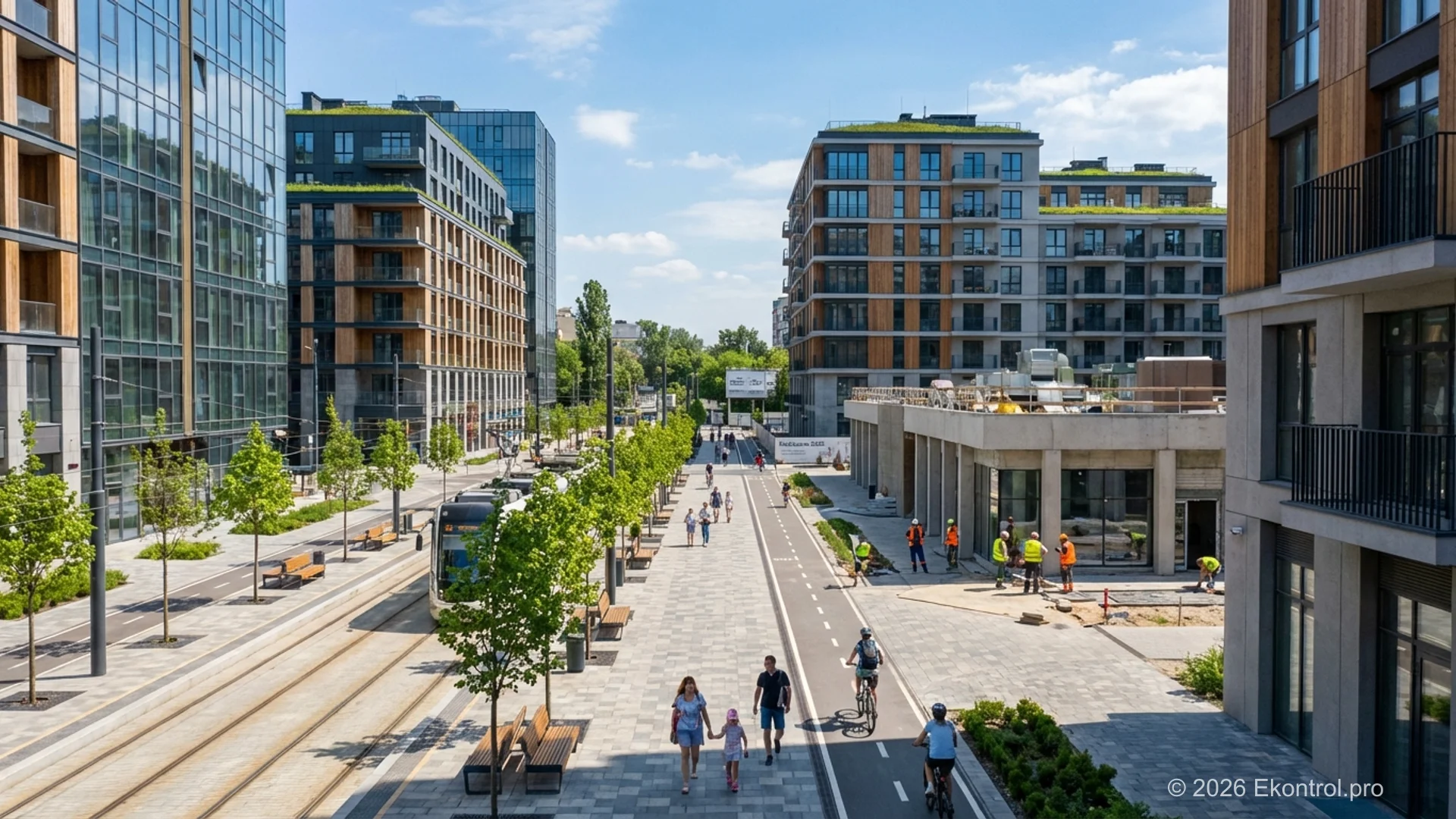
Ukraine's reconstruction is not a single type of task. Housing, transport hubs, hospitals, schools, shelters, logistics, and industrial recovery are all needed simultaneously. Each type of facility has its own requirements, but they all share a demand for speed and safety.
The CFST approach can be useful in scenarios such as:
- Bridges and transport hubs, where high reliability and controlled quality are essential.
- High-rise or mixed-use buildings, where compact load-bearing elements matter.
- Social facilities (schools, hospitals, aid centers) that must operate continuously and for a long time.
- Industrial and logistics complexes, where launch timelines are critical.
The key is to honestly assess local conditions: material availability, contractor competencies, logistics, and maintenance requirements. Then the solution will be practical rather than just "trendy."
Risks and Conditions to Keep in Mind
Even the best standard cannot replace engineering discipline and oversight. For CFST and similar solutions, it is important to consider:
- Material and welding quality, because mistakes at the start are hard to fix later.
- Geometric accuracy and complete concrete filling, so the element performs as designed.
- Corrosion protection and compliance with operating conditions (humidity, chemical exposure, etc.).
- Fire safety and local regulatory requirements.
- A technical inspection plan to ensure structures remain reliable for years.
That is why the design stage should address not only "how to build" but also "how to inspect and maintain." This is precisely what distinguishes fast construction from quality reconstruction.

Where to Start Right Now
For standards to work in real reconstruction projects, a simple and consistent approach is needed:
- Define reconstruction goals: which facilities are priorities, and what safety, energy-efficiency, and accessibility targets are required.
- Include standards in the technical specification: clearly state requirements for design, installation, quality control, and subsequent inspections.
- Choose pilot projects: test the technology and refine approaches on a small number of facilities.
- Prepare teams and quality control: an ISO 9001 quality management system plus environmental and energy practices (ISO 14001, ISO 27001).
- Set up operational monitoring: regular inspections, responsible persons, and transparent documentation.
This is a pragmatic path that helps move from ideas to real, measurable benefits for communities.
Need a Standards Roadmap for Reconstruction?
We will help you select the right standards, prepare your team, and set up quality control for recovery projects.
Submit a requestConclusion
Sustainable urban development is not a "trendy buzzword" but a way to make reconstruction predictable and long-lasting. ISO 14001 provides a clear framework for modern composite structures, while ISO management standards help maintain quality, environmental compliance, and energy efficiency in practice.
For Ukraine, this is an opportunity to build cities we can be proud of: strong, people-centered, and economically sound over the long term. And most importantly, this is a real step toward reconstruction that works not just "until the first repair" but for generations.
Tags
Need a certification consultation?
Free ConsultationWhy Sustainable Cities Matter for Ukraine
After the war, Ukraine needs to rebuild housing, transport, hospitals, schools, utility networks, and industrial sites. This is not just repair — it is a chance to reassemble cities so they serve people for decades. We are talking about thousands of facilities across different regions, where conditions, budgets, and material availability can vary significantly.
Sustainable development in our context is about the long-term horizon. Buildings must be safe, energy-efficient, and accessible for people with different needs. Infrastructure must withstand peak loads, weather risks, and be easy to maintain. In other words, we look not only at "right now" but also at costs and quality over the next 10–30 years.
When a single project brings together communities, the government, donors, investors, and contractors, transparent rules are essential. This is exactly where ISO standards serve as a common language: they establish a minimum level of quality, safety, and control, reduce the number of "grey areas," and speed up decision-making.
What ISO Brings to Sustainable Cities
ISO highlights the role of standards in sustainable urban development, and one of the key documents in this context is ISO 14001. It describes an approach to the design and use of concrete-filled steel tubes (CFST) in composite and hybrid structures.
In plain terms, the standard sets a clear framework: how to calculate such elements, how to organize fabrication and installation, which inspections are needed during construction, and which reviews should be planned during operation. This matters because it provides uniform criteria for different teams and reduces the risk of "improvisation" on critical issues.
For Ukraine, this is especially valuable because transparent, internationally recognized requirements increase the trust of investors and donors. And when the rules are clear, it is easier to plan budgets, timelines, and responsibilities.
In Plain Terms: Concrete + Steel = Faster and Stronger
CFST stands for concrete-filled steel tubes. Imagine a "strong frame" where steel forms the shell and concrete inside reinforces the element under compression. The key idea is simple: the materials compensate for each other's weaknesses and work as a single system.
Why this is interesting for reconstruction in practice:
- The tube doubles as formwork, which can simplify and speed up installation.
- A compact cross-section helps use space more efficiently in dense urban development.
- Greater quality control — part of the work can be done in a factory with repeatable results.
- Easy to scale standardized solutions when cities need similar facilities (schools, clinics, housing).
Important: CFST is not a universal solution for every case. But where speed, predictability, and resource efficiency matter, it can be a strong option.
Where This Can Help Ukraine's Reconstruction
Ukraine's reconstruction is not a single type of task. Housing, transport hubs, hospitals, schools, shelters, logistics, and industrial recovery are all needed simultaneously. Each type of facility has its own requirements, but they all share a demand for speed and safety.
The CFST approach can be useful in scenarios such as:
- Bridges and transport hubs, where high reliability and controlled quality are essential.
- High-rise or mixed-use buildings, where compact load-bearing elements matter.
- Social facilities (schools, hospitals, aid centers) that must operate continuously and for a long time.
- Industrial and logistics complexes, where launch timelines are critical.
The key is to honestly assess local conditions: material availability, contractor competencies, logistics, and maintenance requirements. Then the solution will be practical rather than just "trendy."
Risks and Conditions to Keep in Mind
Even the best standard cannot replace engineering discipline and oversight. For CFST and similar solutions, it is important to consider:
- Material and welding quality, because mistakes at the start are hard to fix later.
- Geometric accuracy and complete concrete filling, so the element performs as designed.
- Corrosion protection and compliance with operating conditions (humidity, chemical exposure, etc.).
- Fire safety and local regulatory requirements.
- A technical inspection plan to ensure structures remain reliable for years.
That is why the design stage should address not only "how to build" but also "how to inspect and maintain." This is precisely what distinguishes fast construction from quality reconstruction.
Where to Start Right Now
For standards to work in real reconstruction projects, a simple and consistent approach is needed:
- Define reconstruction goals: which facilities are priorities, and what safety, energy-efficiency, and accessibility targets are required.
- Include standards in the technical specification: clearly state requirements for design, installation, quality control, and subsequent inspections.
- Choose pilot projects: test the technology and refine approaches on a small number of facilities.
- Prepare teams and quality control: an ISO 9001 quality management system plus environmental and energy practices (ISO 14001, ISO 27001).
- Set up operational monitoring: regular inspections, responsible persons, and transparent documentation.
This is a pragmatic path that helps move from ideas to real, measurable benefits for communities.
Need a Standards Roadmap for Reconstruction?
We will help you select the right standards, prepare your team, and set up quality control for recovery projects.
Submit a requestConclusion
Sustainable urban development is not a "trendy buzzword" but a way to make reconstruction predictable and long-lasting. ISO 14001 provides a clear framework for modern composite structures, while ISO management standards help maintain quality, environmental compliance, and energy efficiency in practice.
For Ukraine, this is an opportunity to build cities we can be proud of: strong, people-centered, and economically sound over the long term. And most importantly, this is a real step toward reconstruction that works not just "until the first repair" but for generations.